47 Founding of Rome
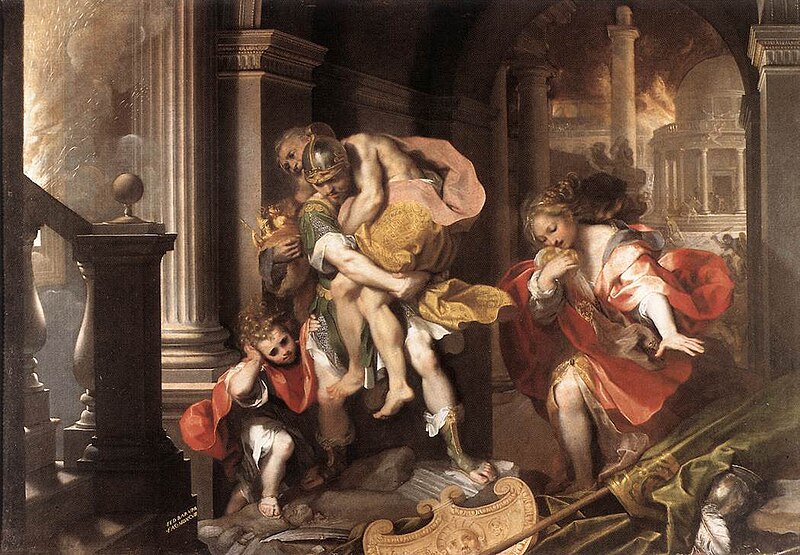
the national epic of mythical Rome, the Aeneid of Virgil, tells the story of how Trojan prince Aeneas came to Italy. The Aeneid was written under Augustus, who claimed ancestry through Julius Caesar from the hero and his mother Venus. According to the Aeneid, the survivors from the fallen city of Troy banded together under Aeneas and underwent a series of adventures around the Mediterranean Sea, including a stop at newly founded Carthage under the rule of Queen Dido, eventually reaching the Italian coast. The Trojans were thought to have landed in an area between modern Anzio and Fiumicino, southwest of Rome, probably at Laurentum or, in other versions, at Lavinium, a place named for Lavinia, the daughter of King Latinus whom Aeneas married. This started a series of armed conflicts with Turnus over the marriage of Lavinia.[3] Before the arrival of Aeneas, Turnus was engaged to Lavinia, who then married Aeneas, starting the war.[3] Aeneas won the war and killed Turnus.[3] The Trojans won the right to stay and to assimilate with the local peoples. The young son of Aeneas Ascanius, also known as Iulus, went on to found Alba Longa and the line of Alban kings who filled the chronological gap between the Trojan saga and the traditional founding of Rome in the 8th century BC.
Toward the end of this line, King Procas was the father of Numitor and Amulius. At Procas' death, Numitor became king of Alba Longa, but Amulius captured him and sent him to prison; he also forced Numitor's daughter Rhea Silvia to become a virgin priestess among the Vestals. For many years, Amulius was the king. The tortuous nature of the chronology is indicated by Rhea Silvia's ordination among the Vestals, whose order was traditionally said to have been founded by Romulus's successor Numa Pompilius.
Sabines, Samnites and Campanians spoke in variations of the Latin's tribal language which was linked to Oscan, enabling them to communicate when they came in contact. Much the same way that the present day French, Spanish and Italian people can understand some of each other's words through their latin roots. Eventually the variations evolved into one commonly used form of latin spoken by the Umbrians
ater colonising tribes came from the Eastern area of the Mediterranean. By the end of the Bronze age the peninsula was dominated by migrating tribes from the Aegean. The influential Etruscans arrived with their highly developed artistic culture, and a language that included an obscure form of the Greek Alphabet. The Greeks settled in the southern part of 'the boot' and Sicily, building Syracuse - one of the greatest cities of the ancient world!
When the Greeks waged war against the city of Troy, the Trojan hero Aeneas sailed across the Mediterranean Sea and founded Lavinium on the Italian Peninsula

No comments:
Post a Comment